Home
/ 部落格列表
/ English
/ Synergy of Metformin and Natural Extracts in MASLD Therapy
文章分類
Synergy of Metformin and Natural Extracts in MASLD Therapy
2026-04-02
Exploring Therapeutic Advances in Metabolic Dysfunction-Associated Steatotic Liver Disease (MASLD): The Synergistic Effect of Metformin and Natural Extracts
I. Research Background and Pharmacological Mechanisms
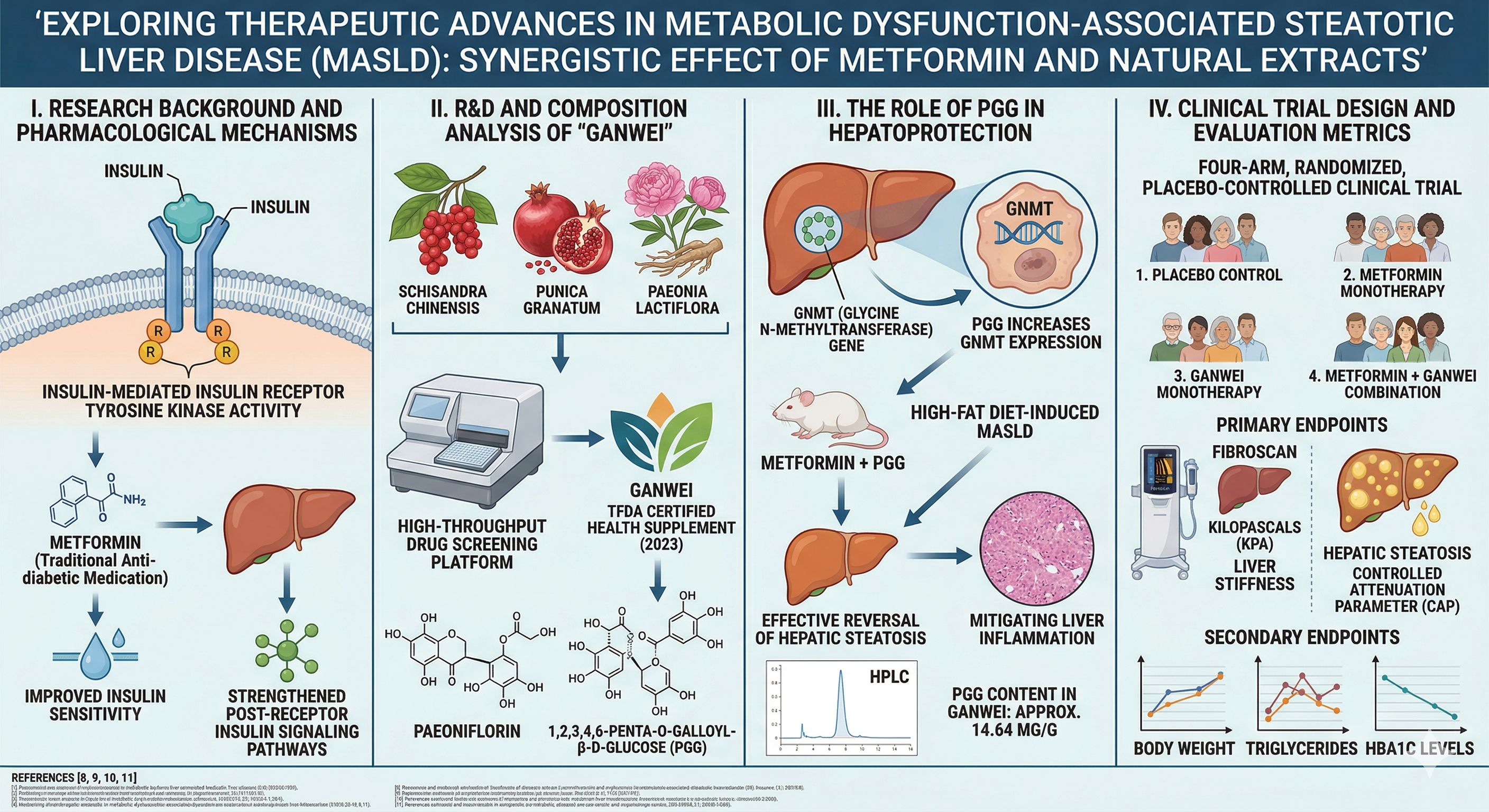
Metabolic Dysfunction-Associated Steatotic Liver Disease (MASLD) has emerged as a significant global public health challenge. In terms of pharmacological treatment, Metformin, a traditional anti-diabetic medication, has been shown to improve insulin sensitivity by increasing insulin-mediated insulin receptor tyrosine kinase activity and strengthening subsequent post-receptor insulin signaling pathways. Based on these mechanisms, Metformin is considered to have potential therapeutic efficacy for MASLD.
II. R&D and Composition Analysis of "Ganwei"
In the development of health supplements, "Ganwei" received the "Health Food" certification from the Taiwan Food and Drug Administration (TFDA) in 2023. This product is primarily composed of herbal extracts from Schisandra chinensis, Punica granatum (pomegranate), and Paeonia lactiflora (peony).
According to literature, Ganwei was developed using a "high-throughput drug screening platform" specifically targeting the activation of the GNMT (Glycine N-methyltransferase) gene [8]. Research indicates that Paeoniflorin and 1,2,3,4,6-Penta-O-galloyl-β-D-glucose (PGG) are its primary active components [8, 9].
III. The Role of PGG in Hepatoprotection
High-performance liquid chromatography (HPLC) results show that the PGG content in Ganwei is approximately 14.64 mg/g. PGG, a natural glycoside, has been confirmed as the core component in Paeonia root extract capable of increasing GNMT expression [8]. In preclinical animal studies, Paeonia has been proven effective in mitigating liver inflammation [10].
Notably, a 2022 study pointed out that in mouse models of MASLD induced by a high-fat diet, the combination of PGG and Metformin effectively reversed hepatic steatosis [11].
IV. Clinical Trial Design and Evaluation Metrics
Based on the aforementioned research, a "four-arm, randomized, placebo-controlled" clinical trial has been initiated. The study aims to investigate the safety and efficacy of "Metformin monotherapy," "Ganwei monotherapy," and the "combination of both" in patients with MASLD.
The primary endpoints of the trial include:
Degree of Hepatic Steatosis: Measured via the Controlled Attenuation Parameter (CAP).
Liver Stiffness: Evaluated using FibroScan scores in kilopascals (kPa).
Secondary endpoints include safety assessments, liver function indicators, and the patients' metabolic profiles (such as body weight, triglycerides, and HbA1c levels).
References
[8] Kant, R., et al. (2016). Identification of 1,2,3,4,6-Penta-O-galloyl-β-d-glucopyranoside as a Glycine N-Methyltransferase Enhancer by High-Throughput Screening of Natural Products Inhibits Hepatocellular Carcinoma. Int. J. Mol. Sci., 17, 669.
[9] Xu, S., et al. (2023). DUS evaluation of nine intersubgeneric hybrids of Paeonia lactiflora and fingerprint analysis of the chemical components in the roots. Front. Chem., 11, 1158727.
[10] Zhang, L., & Schuppan, D. (2014). Traditional Chinese Medicine (TCM) for fibrotic liver disease: Hope and Hype. J. Hepatol., 61, 166–168.
[11] Yang, M.-H., et al. (2022). Reversal of High-Fat Diet-Induced Non-Alcoholic Fatty Liver Disease by Metformin Combined with PGG, an Inducer of Glycine N-Methyltransferase. Int. J. Mol. Sci., 23, 10072.